How to Build AI Feature Roadmap: A Step-by-Step Guide for Better Customer Journey (2026)
Learn how to build an AI roadmap customer journey with a clear step-by-step guide. Improve customer experience, alignment, and outcomes in 2026.
Dec 19, 2025
Product managers have embraced AI and machine learning, with 61% already using these technologies to tackle business challenges.
AI-driven customer experience strategies are changing how businesses connect with their audiences. Research shows that companies using AI have improved their product development by 25-30%. Most customers (73%) expect brands to provide tailored interactions, but only 60% feel satisfied with current personalization efforts.
The global AI market will reach $190 billion by 2026. This makes it crucial to develop your AI feature roadmap that matches your customer's experience stages. AI technology can analyze thousands of customer comments, survey responses, and usage patterns within minutes. This analysis reveals common pain points that would take weeks for humans to uncover.
This piece will guide you through creating a customer-centric AI roadmap that enhances every touchpoint in your customer's experience. You will learn to identify hidden opportunities and build smarter products that strike a chord with your audience.
Understanding the AI-Powered Customer Journey
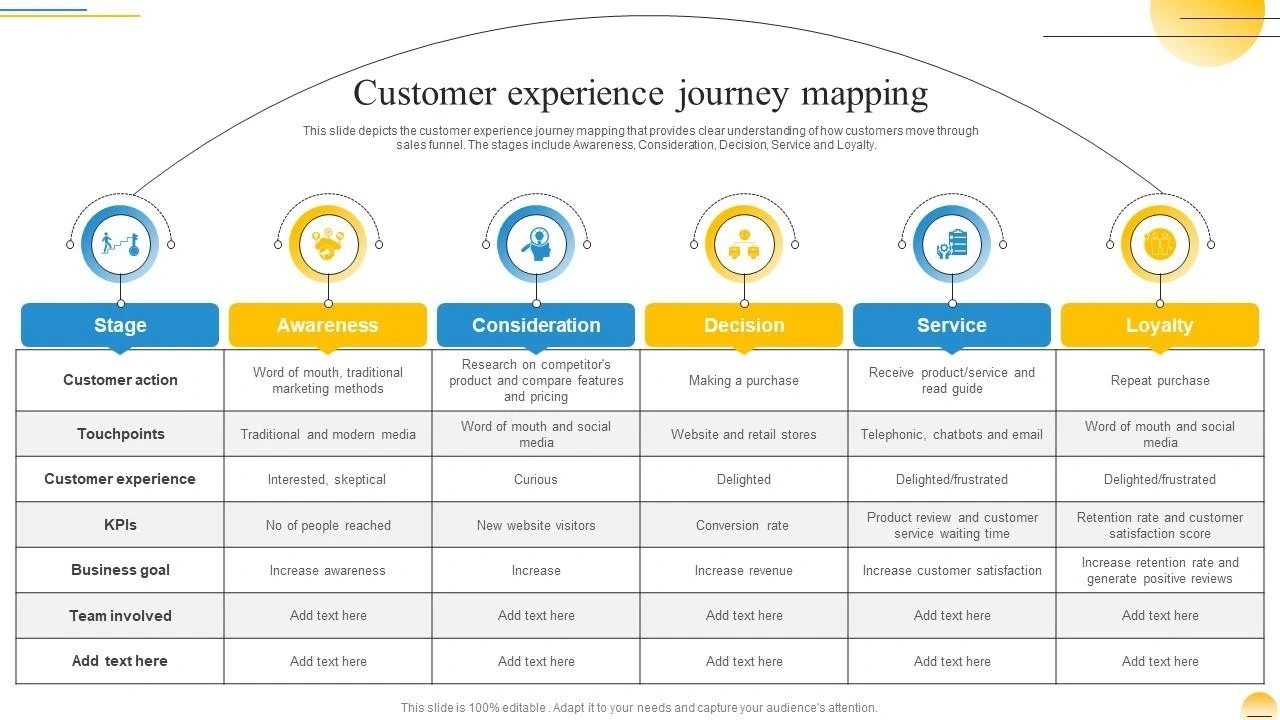
Image Source: SlideTeam
Customer journey mapping has grown beyond simple documentation into a dynamic, data-driven process. A customer journey roadmap visually shows how customers interact with your brand - from their first contact to long-term relationships. This approach helps businesses spot crucial touchpoints and problems to build customer loyalty and create better experiences.
Most traditional journey maps depend on occasional research and manual data collection. AI-powered journey mapping, however, updates and refines customer maps automatically with new data. This change matters a lot - 85% of businesses now see customer journey expertise as crucial, and 81% put more money into AI to improve customer experiences.
Why AI is essential for modern journey mapping
AI makes journey mapping more powerful by analyzing massive amounts of customer data from every touchpoint live. Traditional methods only give you snapshots in time, but AI creates living documents that adapt to customer behavior changes. AI can spot hidden patterns that humans might miss. This helps you understand your customers' actions and their motivations better.
The numbers tell a compelling story. Companies that use AI journey mapping see double or triple ROI (43% and 22% respectively). AI-driven personalized paths can also boost ecommerce revenues by 3% to 5%.
Key stages: awareness, consideration, decision, loyalty
Customer journeys typically move through four main stages:
- Awareness: Customers recognize they have a problem and look for solutions. AI improves this stage by analyzing behavior patterns to understand user intent during first contact.
- Consideration: Prospects compare features, pricing, and reviews. AI uses predictive analytics to identify priorities and deliver relevant content through the best channels.
- Decision: Prospects become customers by making a purchase. AI makes buying easier with chatbots and live assistance that provide detailed information.
- Retention/Loyalty: Post-purchase experiences determine if customers come back and recommend your brand. Getting new customers costs five times more than keeping existing ones.
AI doesn't just improve the customer journey - it creates what Boston Consulting Group calls an "influence map" that updates daily and runs on its own.
Mapping AI Features to Each Journey Stage
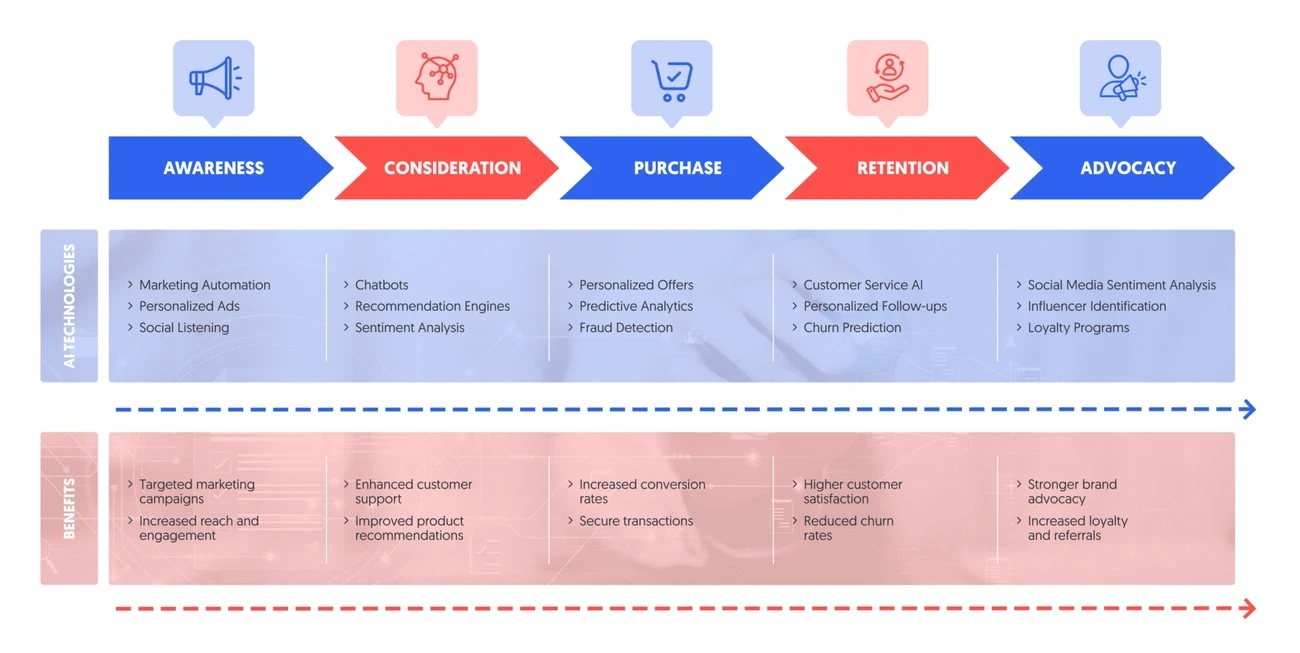
Image Source: New Metrics
Let's get into specific AI features that boost each phase of the AI-powered customer trip. This approach helps create an effective AI feature roadmap that matches what customers need.
Awareness: AI for content customization and discovery
AI analyzes customer data and behavioral insights to deliver personalized content that introduces your brand during the awareness stage. Brands see a 1.5x boost in customer loyalty when they get personalization right. AI looks at browsing patterns and demographics to figure out which content will appeal most to potential customers.
To name just one example, streaming services use AI to pick movie cover art based on your priorities when you browse. While many current personalization attempts feel off-target to more than 50% of consumers, the right AI implementation connects digital and physical touchpoints. This creates experiences that feel unique rather than generic.
Consideration: AI for comparison and education
Prospects review their options during the consideration phase. AI-powered product comparison tools utilize machine learning to suggest similar products. They use generative AI to summarize information and point out key differences. These tools study customer behavior to predict purchase intent and reveal opportunities for upselling or cross-selling.
Advanced AI systems can spot patterns in user behavior, predict churn risk, and uncover unexpected product usage insights. This helps customers make better decisions.
Decision: AI for conversion and reassurance
AI conversion rate optimization turns static checkout sequences into adaptive experiences at the decision stage. Every message and timing decision comes from data. AI spots when a shopper's attention drops and sends timely prompts. These keep momentum going without overwhelming the customer.
AI decisioning weighs goals like protecting margins or increasing lifetime value. It then customizes offers - high-value customers might see loyalty perks while first-time buyers get lighter incentives.
Post-purchase: AI for onboarding and retention
AI creates customized onboarding experiences after purchase to boost retention. Studies show 86% of customers become more loyal with excellent onboarding. AI studies user behavior to spot patterns, priorities, and potential churn risks. This enables proactive support.
AI also updates loyalty programs by rewarding actions beyond purchases. Activities like giving feedback, completing quests, or sharing on social media create meaningful connections. These turn customers into brand promoters.
Creating an AI Feature Roadmap That Aligns with Customer Needs
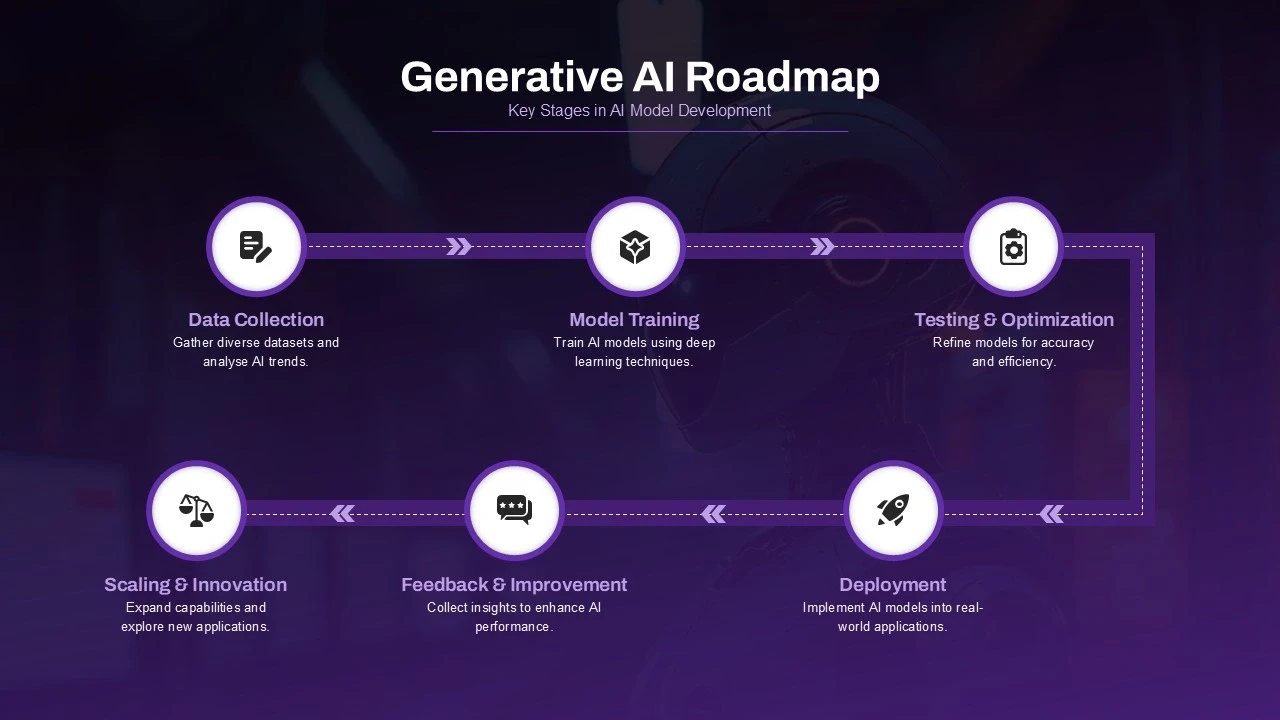
Image Source: SlideBazaar
Building an effective AI feature roadmap starts with understanding what your customers truly value. Your implementation will succeed when it matches customer needs at every stage of their experience.
Identify high-impact touchpoints
AI investments work best when they target areas of friction in your customer's experience. Companies that use AI-powered customer analytics have seen higher satisfaction and revenue - up to 73%. You should focus on complex, high-volume processes like authentication where AI can eliminate barriers and create smooth experiences.
Use AI to surface journey gaps
AI excels at finding gaps in your customer's experience. Through semantic clustering, AI analyzes your knowledge base and spots patterns humans might miss. This helps detect bottlenecks before problems become systemic—such as subtle increases in search queries after a new feature release.
Prioritize features based on journey value
A evidence-based approach using Customer Effort Score (CES) helps identify friction points. You can create an AI-powered matrix that plots Customer Effort Score against Development Effort. The features in the top-left quadrant need immediate attention - these address high customer effort but require low development work.
Balance short-term wins with long-term vision
Your AI roadmap needs clear phases. The process should begin with simple AI automation to gain early momentum. Quick wins help build credibility and generate revenue for bigger projects while providing valuable user feedback. Finding the right balance between immediate needs and long-term goals is vital—companies that focus only on short-term gains risk falling behind competitors who invest in transformative AI.
Need help with your AI feature roadmap? Contact our experts to match your AI strategy with your customer's needs.
Implementing and Scaling Your AI Roadmap
The successful execution of an AI roadmap demands a systematic approach. Organizations need strong digital and data systems, as 45% cite their inadequacy as implementation barriers.
Start with a pilot use case
Your first AI project should target a simple yet valuable business case. Select a specific dataset or department where you can measure results easily. A successful pilot will verify two vital elements: technical feasibility and user adoption. This strategy helps you win support while delivering quick results.
Integrate with existing tools and workflows
Your AI solutions should blend with current systems. This integration will give a seamless experience where users can access AI within their daily tasks instead of switching to different portals. Before making substantial investments, organizations should check if their technology infrastructure, data governance, and ethical frameworks can support AI solutions at scale.
Monitor performance and adjust
You need detailed metrics to evaluate progress continuously. Your key performance indicators could track model deployment time, automated pipeline percentages, and system metrics like uptime and error rates. A universal control group and target group will help you learn about customer behavior patterns.
Build cross-functional teams
The core team should include members from IT, business units, legal, compliance, and human resources. This integrated approach creates smooth implementation throughout the organization. Do you need help with your implementation framework? Contact our experts to build your AI roadmap.
Conclusion
AI-powered customer journey mapping revolutionizes how businesses connect with their audiences. This piece shows how smart AI implementation at each stage creates tailored experiences that substantially outperform traditional approaches.
The move from static to dynamic journey mapping yields remarkable benefits. Companies that embrace AI witness impressive ROI improvements and enhanced customer satisfaction. AI doesn't just improve experiences incrementally - it completely changes them.
Creating an effective AI roadmap demands close attention to customer needs at every touchpoint. A balanced approach comes from spotting high-impact areas, finding journey gaps, and ranking features by effort scores. This delivers both quick wins and lasting value.
Success stems from beginning with focused pilot projects before growing further. Teams can verify technical feasibility, track actual adoption, and adjust as needed before scaling up.
Note that your AI roadmap must adapt to changing customer behaviors and new technologies. Successful organizations treat their AI strategy as a living document, not a one-time task. They track performance metrics constantly and fine-tune their approach based on ground feedback.
Tomorrow belongs to companies that expertly combine AI capabilities with human touchpoints throughout the customer experience. You'll create smarter products that appeal to your audience and drive measurable business results by doing this and being systematic.
Want to change your customer experience? Begin small, track carefully, and grow strategically. Your AI-powered journey begins now - and your customers will appreciate the difference.
FAQs
Q1. How can AI enhance the customer journey mapping process? AI transforms customer journey mapping by continuously analyzing vast amounts of data across all touchpoints in real-time. This creates dynamic, evolving maps that reflect changing customer behaviors and uncover subtle patterns human analysts might miss.
Q2. What are the key stages of an AI-powered customer journey? The key stages of an AI-powered customer journey typically include awareness, consideration, decision, and loyalty. AI enhances each stage by personalizing content, providing intelligent comparisons, optimizing conversions, and creating tailored retention strategies.
Q3. How do you prioritize AI features in a customer journey roadmap? Prioritize AI features by identifying high-impact touchpoints, using AI to surface journey gaps, and creating a matrix that plots Customer Effort Score against Development Effort. Focus on features that address high customer effort with low development effort for immediate improvements.
Q4. What's the best approach to implementing an AI roadmap? Start with a pilot use case that demonstrates clear business value. Integrate AI solutions with existing tools and workflows, continuously monitor performance metrics, and build cross-functional teams to ensure comprehensive planning and smooth implementation across the organization.
Q5. How can AI improve customer retention and loyalty? AI enhances retention and loyalty by creating personalized onboarding experiences, analyzing user behavior to identify churn risks, and modernizing loyalty programs. It can reward actions beyond purchases, such as providing feedback or sharing on social media, creating meaningful connections that transform customers into brand advocates.
Next step
If this is a workflow you are deciding whether to build, KUMO builds production AI for growing businesses: see AI workflow automation and AI product and platform engineering, or read how Equipp was built. For a cost range on your own scope, the AI development cost calculator takes a minute; to talk it through, book a free 30-minute call with an engineer.